Why Do Women Founders Feel So Lonely?
Female founder loneliness is real and common. Learn why women entrepreneurs feel isolated and get concrete fixes that actually work—not just platitudes.
Kinhive Team · July 9, 2026 · 7 min read

On this page+
If you’ve ever sat alone after a hard founder decision and thought “nobody around me actually gets this,” you’re not broken and you’re not alone. A 2018 study published in the Journal of Business Venturing found that 72% of entrepreneurs report experiencing mental health challenges, with isolation and loneliness ranking among the most common. For women founders specifically, that number skews even higher. The reasons are structural, not personal, and understanding them is the first step to doing something about it.
Is it normal to feel lonely as a founder?
Yes, genuinely normal. Founding a company puts you in an unusual position that most people in your life simply can’t relate to. Your team looks to you for direction. Your family wants to be supportive but doesn’t fully understand the stakes. Your friends think you’re living the dream. Meanwhile, you’re making high-pressure decisions daily, often without a sounding board who has real skin in the game.
Small team size makes it worse. When you’re a solo founder or running a team of two or three, there’s no leadership peer sitting next to you. There’s no colleague at your level to debrief with after a tough call. The weight of decisions lands entirely on you, and there’s nowhere to put it down at the end of the day.
This isn’t a mindset problem. It’s a structural one. The founder role is designed to be lonely by default unless you actively build the community around it that doesn’t come automatically.
Why is founder loneliness worse for women?
Women entrepreneurs face the same baseline isolation as any founder, plus a few additional layers that compound it significantly.
First, representation gaps in traditional networking spaces mean women are often the only person like them in the room. Investor dinners, industry events, and accelerator cohorts still skew heavily male. When you’re the only woman at the table, it’s hard to be fully honest about what you’re experiencing. There’s a real cost to vulnerability in rooms where you’re already having to prove you belong.
Second, the emotional labor that women are often expected to absorb, both at work and at home, leaves less room for the kind of peer connection that would actually help. You’re already spending a lot of energy managing other people’s feelings. Finding people who can hold space for yours requires intentional effort that can feel like one more thing on the list.
Third, women-focused founder communities have historically been underfunded and underbuilt. The infrastructure that might have helped, like peer groups, mentorship networks, and coworking communities built with women in mind, simply didn’t exist at scale until recently.
Research backs this up. A report from the Kauffman Foundation found that women entrepreneurs are significantly less likely than their male counterparts to have access to strong professional networks, which directly correlates with both business outcomes and self-reported wellbeing. Isolation isn’t just emotionally painful. It’s a business disadvantage.
How do I deal with founder isolation as a woman entrepreneur?
This is where most advice fails you. You’ll read things like “join a community” or “find a mentor” without any guidance on what that actually looks like in practice. Here are concrete things that move the needle.
Find a peer accountability structure, not just a support group
There’s a meaningful difference between a space where founders vent and a space where founders hold each other to real commitments. Look for a small peer group of three to five women at a similar stage who meet regularly, share honest updates including the hard ones, and push back on each other’s thinking. This is different from a general networking event. The goal is depth over breadth.
If you can’t find one, start one. Reach out to two or three women you’ve crossed paths with and propose a monthly video call with a simple structure: what’s working, what’s hard, what do you need. Most people will say yes because they’re looking for the same thing.
Make your progress visible, even when it’s messy
One of the quietest contributors to founder loneliness is the habit of only sharing wins publicly. When your feed, your LinkedIn, and your conversations only reflect polished milestones, you cut yourself off from the kind of honest connection that actually breaks isolation. Sharing work in progress, even rough drafts and half-formed ideas, signals that you’re a real person building something real, and it invites others to do the same.
Kinhive’s community feed is built specifically for this. It surfaces posts from all members as well as people you follow, so you’re not just seeing curated highlights from the same five accounts. You’re seeing what women are actually building day to day, which makes it far easier to reach out, relate, and connect without the performance anxiety of traditional social media.
Use coworking as a loneliness antidote, not just a productivity hack
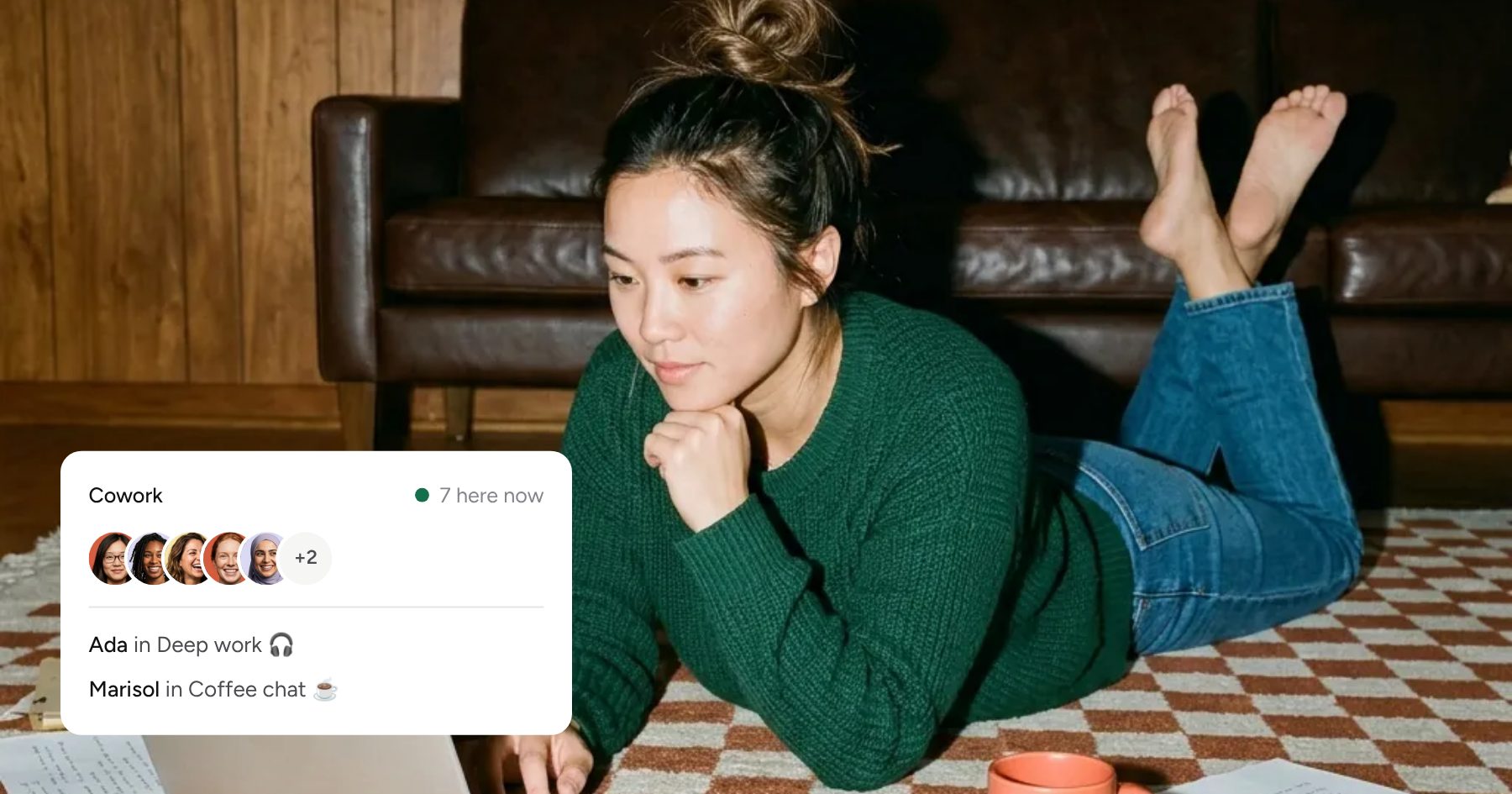
Coworking gets talked about mostly in terms of focus and productivity. But its real value for founders is social. Having other people around you while you work, even if you’re not talking to them, breaks the psychological isolation of building alone. It normalizes the experience. You see other people struggling and pushing through and that matters more than most founders admit.
Physical coworking spaces are great if you have access to one. But for remote founders, especially those outside major cities, virtual coworking is a legitimate substitute. Showing up to a video room with other women founders for two focused hours does something to the loneliness that a solo Pomodoro timer simply doesn’t replicate.
Let technology do the hard part of introductions
One of the biggest friction points in building a peer network is the awkwardness of cold outreach. It’s hard to message someone you don’t know and say “I think we should be friends and peers.” Most people don’t do it, which means most people stay isolated even when the right connections exist nearby.
AI-powered matching removes that friction entirely. Kinhive’s AI matchmaking introduces you to other women in the community based on how you work, what you value, and what you’re building. Every introduction comes with a clear reason why it’s relevant, so you’re not guessing whether the connection makes sense. You get context, which makes it dramatically easier to actually follow through. Daily prompts surface fresh connections so the network stays active rather than something you signed up for and forgot about.
Kinhive was founded by identical twin sisters who spent years watching women build things largely alone, without the peer infrastructure that makes that sustainable. That origin shapes everything about how the platform is designed: not as a directory or a feed to scroll, but as a genuine connective tissue between women who are building.
Join a community where quality matters more than size
Big open communities often feel paradoxically lonelier than smaller ones. When anyone can join, the signal-to-noise ratio drops and the sense of shared context disappears. The most valuable communities for founders tend to be curated and intentional, places where you know the other people actually belong there and are showing up in good faith.
This is why invite-only and application-based models exist. They’re not about exclusivity for its own sake. They’re about creating the conditions where real trust and real connection can develop. When you know everyone in the room went through some kind of vetting, you lower your guard a little, and that’s where the actually useful conversations happen.
FAQ: female founder loneliness and isolation
Is founder loneliness a mental health issue? It can be. Chronic isolation is a known risk factor for anxiety and depression, and founders already face elevated mental health risks due to stress and uncertainty. If loneliness is significantly affecting your daily functioning or mood, speaking with a therapist who understands entrepreneurship is a legitimate and worthwhile step, not a weakness.
Do male founders feel this too? Yes, but research consistently shows that women founders report higher levels of isolation and have less access to the peer networks that help address it. The experience is shared but not identical.
How do I find other women founders to connect with? Start specific: look for communities organized around your stage, industry, or geography rather than just “women in business” broadly. Specificity creates more useful common ground. Curated platforms with AI-assisted introductions can also dramatically shorten the time it takes to find the right people.
What if I’m an introvert and networking feels exhausting? Most founder networking advice is built for extroverts, which makes it largely useless for introverts. One-on-one introductions through a platform that tells you why the match was made are far less draining than open networking events. Asynchronous community feeds let you engage on your own timeline without the pressure of real-time performance.
How much time do I need to invest in community to feel less isolated? Less than you think. Research on social connection suggests that even two or three meaningful interactions per week can significantly reduce the subjective experience of loneliness. You don’t need to be active everywhere. You need one or two spaces where you show up consistently.
Is virtual coworking actually effective? For most people, yes. Studies on remote work wellbeing suggest that ambient social presence, simply being around others even without direct interaction, meaningfully reduces feelings of isolation. Virtual coworking recreates that ambient presence without requiring you to leave your home office or commute anywhere.
Female founder loneliness is real, it’s common, and it’s not something you can think your way out of. The fix is structural: build the peer infrastructure that the founder role strips away, use every tool available to make good introductions faster, and show up somewhere consistently enough that real trust can form. You don’t need a massive network. You need a few people who genuinely get it.
If you’re ready to find them, Kinhive is a private, application-based community built specifically for women who are building. AI-curated introductions, a community feed where women share real work in progress, and virtual coworking spaces to work alongside others who understand the founder experience, all free to use. Apply to join and meet the women who will actually get what you’re going through.